
Repeated harvesting trial as a possible cultivation strategy for Sugar Kelp in Norway January 20, 2020

One of the topics GENIALG studies is how the manipulations of seaweed cultivation can be used to increase the yield of produced biomass. One such attempt is to carry out partial harvesting of the sugar kelp, Saccharina latissima biomass during the normal spring harvesting season, leaving the remaining, lower part of the kelp for regrowth during the summer and a possible additional harvest in the following autumn or later. Several harvests on each round of seedling production and deployment could be economically beneficial. This cultivation strategy has been shown to work successfully in the Faroe Islands but has never been demonstrated in Norway, where epiphytic organisms settle on the kelp blades leading to deterioration of the biomass during the summer months.
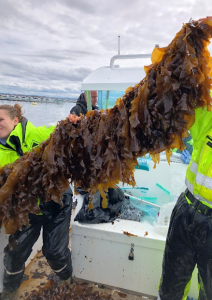
Figure 1. The first harvesting of the sugar kelp in May 2019. At this stage 70% of the biomass was harvested, leaving the remaining parts of the blade for re-growth throughout the summer.
Video clip of first harvest – May 2019
The aim of the presented experiment was to see whether it is possible to do a partial harvest before the main epiphytic settlement happens, by doing one harvest of ca 70% of the biomass in the middle of May, and have a regrowth of fresh tissue for another final harvest at the end of the summer. The experiment was carried out by SINTEF Ocean and Seaweed Energy Solutions (SES) during the spring and summer of 2019. In May 2019, the harvest was slightly below 3kg biomass per metre on the cultivation lines used for the experiment. On half of the lines, the kelp was cut ca 15cm from the stipes (Fig.1), leaving the other half as a control. The lines were redeployed until the end of August 2019 when a team went out for a final harvest. The growth of the cut kelp was better than that of the control lines and gave an overall larger biomass than from the control lines (Fig. 2). No attempts were made to measure qualitative or quantitative differences in the biofouling of the two biomasses in August at this stage.
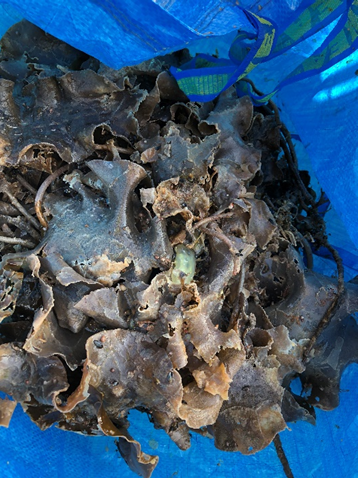
When the kelp was left for a longer growth period, this biomass was unfortunately not only kelp. The blades were entirely covered by bryozoans and other creatures like caprella (skeleton shrimps) and blue mussels. The use of this blend of kelp with epiphytic organisms is not suitable as human food (Fig.3). However, if there is an alternative use of the August-harvest biomass, this method could also be of use in Norway, as clean, fin-food quality kelp can be harvested until early May and a large biomass can be obtained for other industrial purposes three months later. The work will proceed to reveal the changes in the chemical composition from May to August and to find a possible application for such biomass.
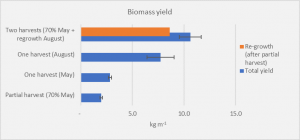
Figure 2. Biomass yield from harvest in May and August.
Video clip of second harvest – August 2019

For more information contact: Dr Jorunn Skjermo – Senior Research scientist, SINTEF Ocean